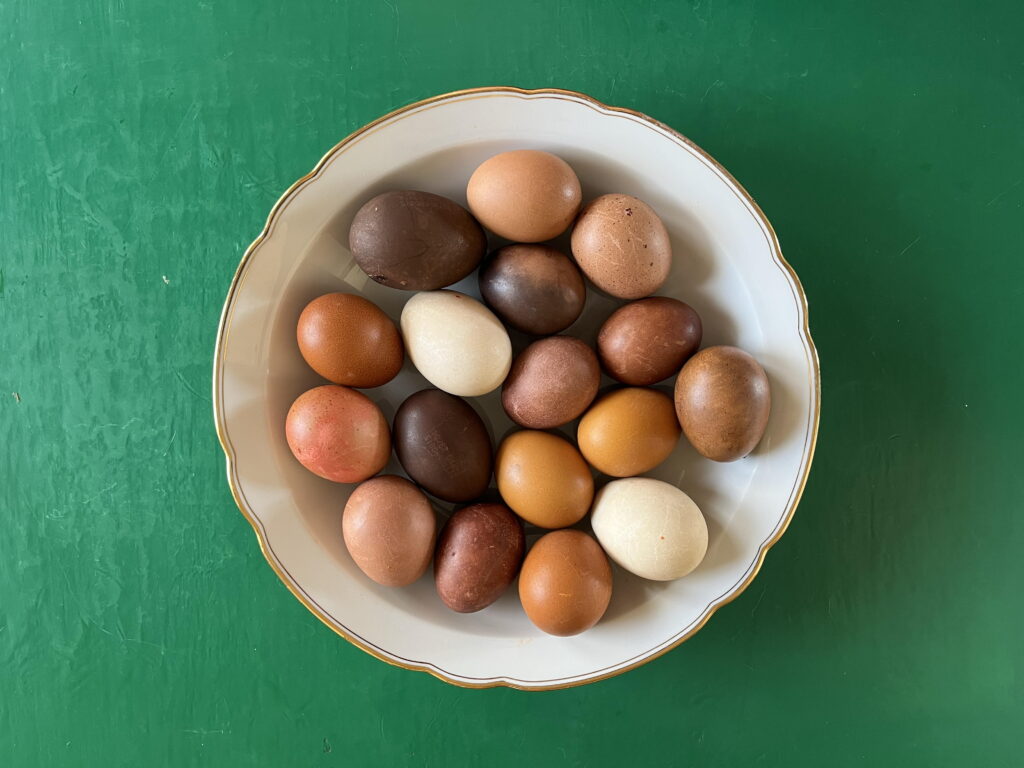
’You don’t play with your food!’ — that’s what I was told time and time again as a child. Strangely enough, there was one seasonal exception to this rule.
I grew up in Switzerland with the Easter tradition of tapping eggs against one another. We would dye hard-boiled eggs in various colours and patterns, sometimes quite artistically, only to break them later. The game goes like this: a group of people gathers around a table or even out on the street. Some hold their Easter eggs so that the pointed end acts as a striking instrument, whilst others hold their eggs firmly to expose the pointed end to the blow. If the blow leaves a dent in the shell of the exposed egg, its holder turns it round to expose the other end of the egg to the next blow. If, on the other hand, the blow leaves a dent in the striker’s egg, it is they who turn it over to expose the other end to the blow, which is now delivered by the previously passive player. Players with eggs bearing two dents drop out, unless more than one egg per player is permitted. The owner of the last egg that does not have two dents is the winner. However, winning this game has no significance; everyone simply eats the eggs they have brought with them.
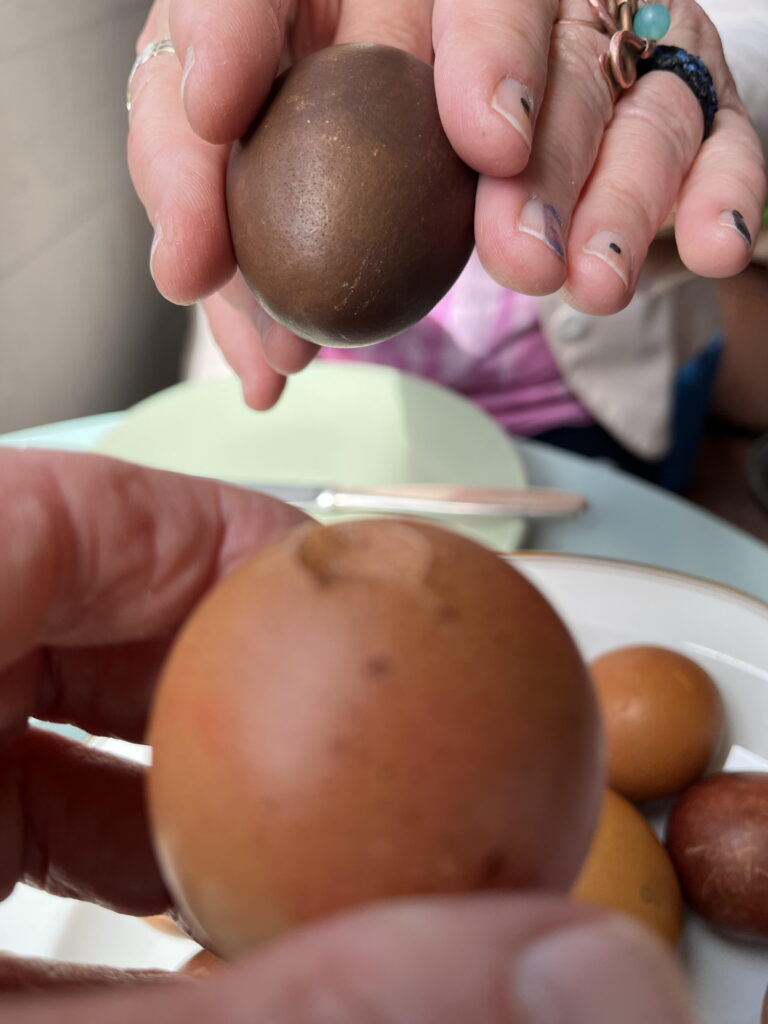
The winner takes it all
I always thought that this sort of Easter egg tradition – where you first search for eggs hidden all over the place – was known throughout Europe; a childish belief, as it turned out, when I came to Austria, where people looked at me as if I were daft when I tried to tap eggs together. In return, they shocked me by eating the eggs with grated horseradish.
It was only this year that I learnt that the Easter egg-tapping tradition is also practised in parts of Italy. In some villages in the Marche region, people gather with their eggs, but unlike in Switzerland, the winner gets all the cracked eggs. [1]
In Friuli, the dents in the eggs are purely accidental: You let the egg slide down a concave roof tile fixed to the top of a sand mound, from where it rolls down until it lands in the ‘truc’, the mould at the foot of the mound. The aim is to hit other eggs already lying in the truc, which may sound like boccia, but without affecting the path of the egg. The owner of an egg that has hit may try again immediately, whilst the owner of a hit egg must leave a coin in place of his egg to be allowed to play another round. The game continues until the end of the day. I’m not sure who gets the money; probably the association that organised the truc.
In all of the above cases, however, there are experts who claim to know which egg to choose to get the very hardest one, and there are usually endless theories about how to select the egg, how to hold it, and how to tap or let it be tapped. As for me, I enjoy painting the eggs and eating them — a rare exception in my otherwise strict vegan diet.
On dyeing brown-shelled eggs
Strangely enough, I can’t find any white-shelled organic eggs in Italian supermarkets. It seems that brown shells are generally seen as proof that the hens are kept free-range and fed the best ingredients. Both of these assumptions are incorrect: the colour of the eggshell depends solely on the breed. To be sure you’re getting free-range eggs from hens raised on a healthy diet, you need to look for an EU-approved organic label.
Have you ever tried dyeing eggs by boiling them with different vegetables and herbs? Every year before Easter, I turn my kitchen into a laboratory for natural dyes. The problem with brown-shelled eggs is similar to painting on a canvas primed with brown: you end up with various shades of brown (see title picture), which can be pretty, but boring if you’re looking for more variety. That’s why I took the liberty of buying four eggs from hens kept ‘on the floor’, as it is called in Italian or German — a term designed by the industry on purpose to make it understood by many consumers as free-range, although it actually refers to hens kept by the thousands in enclosed barns, leaving the individual birds with almost no space to move about. The punishment followed immediately: two of these eggs refused to turn yellow, whilst the other two turned just as dark brown as the brown-shelled ones when boiled with the same dye. To be continued in 2027.
Sources:
[1] https://www.lemarchezozze.it/2023/04/05/la-tradizione-della-scoccetta-a-patrignone/
[2] https://www.cividale.com/_it/news/la_pasqua_a_cividale_del_friuli/1507#google_vignette
Kommentare, Fragen
bitte an mich senden an, samt der Angabe, ob ich den Kommentar hier unter deinem Namen veröffentlichen darf.